
How to Check Criminal History in Jefferson County
Begin by deciding which fact needs proof. Missouri Case.net is the best first stop for a charge filed in the 23rd Judicial Circuit. The Jefferson County Circuit Clerk supplies certified copies and public documents that are not posted. A recent arrest, incident report, or county jail stay starts with the arresting agency or Jefferson County Sheriff. MACHS answers a different question by returning open Missouri criminal history, while the Missouri Department of Corrections tracks qualifying state custody and supervision.
Gather the full legal name, date of birth when lawfully available, spelling variants, an approximate event date, and any case, ticket, incident, booking, or warrant number. Those details reduce false matches. Then follow a deliberate sequence:
- Search Case.net by litigant name, or use the exact case or ticket number when known.
- Limit the court to Jefferson County and compare the public case details before choosing a same-name result.
- Contact the agency that made the incident or arrest report for the original local record.
- Check the county inmate portal or jail line for current custody, and use MODOC for state custody or supervision.
- Order a MACHS name or fingerprint check when statewide identity-based history is the real need.
- Ask the Circuit Clerk for a public document or certified copy that the online docket does not supply.
Do not treat one blank search as a final answer. A recent event may not yet have reached court, and a closed or confidential file may not display. The detailed Jefferson County criminal court case record route is useful once a filed case number is known.
Why Jefferson County Records Span Systems
Jefferson County criminal records do not live in one master county file. The sheriff or city police first creates an incident or arrest report. Jail staff create a booking and custody entry. The prosecutor decides what state charge to file, and the Circuit Clerk maintains the judicial case. Fingerprint-supported arrest cycles and reported dispositions can then reach the Missouri State Highway Patrol repository. A prison sentence or state supervision adds a MODOC record.
The record path is best read as a process: Incident or arrest → booking → prosecutor review → court case → disposition reporting → state history or corrections record. Each stage has its own purpose. Booked charges may differ from charges filed later, and a court disposition may take time to reach another system.
The Jefferson County Sheriff’s official homepage shows the county law-enforcement starting point.

The sheriff’s site leads to report, jail, contact, and public-safety channels, but the court and state systems remain separate.
Official Missouri Background Checks
The Missouri State Highway Patrol Criminal Justice Information Services Division is the central criminal-history repository. Its Missouri Automated Criminal History Site, or MACHS, offers a public personal-identifier name search. The current charge is $15 plus an online convenience fee. It is a possible-match product, not a positive fingerprint identification and not a full copy of every record held by the state.
Open MACHS results can include convictions, arrests less than 30 days old, prosecutor-filed charges awaiting final court disposition, and suspended imposition of sentence entries while probation remains active. Fingerprints are the better route for reviewing one’s own record when identity must be tied to the result. Registration uses the MACHS Fingerprint Search Portal and Missouri’s contracted IDEMIA/IdentoGO channel. The SHP-158 form also supports mail or CJIS public-window requests, while an FBI Identity History Summary is a separate nationwide self-review. State fingerprint results generally take seven to ten business days.
The official MACHS fingerprint registration interface shows where that identity-based process begins.
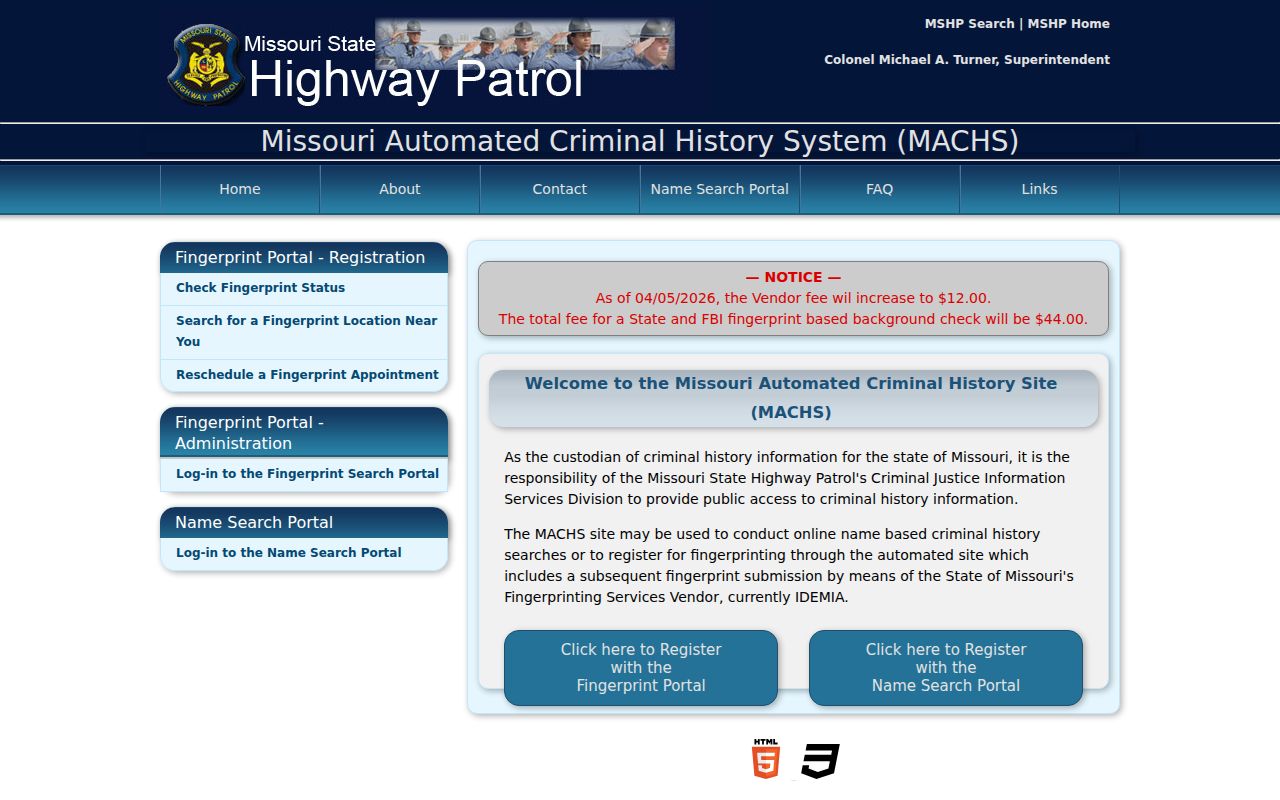
The portal is a state check channel, so it supplements rather than replaces the Jefferson County court file or sheriff report.
Jefferson County Case.net Search Fields
Missouri Case.net is the statewide public court search for Jefferson County criminal cases. It provides several routes rather than one broad name box. A litigant-name search works only when the person is indexed as a litigant. An exact case number is more precise, while filing-date and scheduled-hearing searches help when a date is known. Choose Jefferson County or the 23rd Judicial Circuit to keep results local.
| Search route | Key input | Best use |
|---|---|---|
| Litigant Name | Last or business name; optional first and middle names | Finding a case when no number is known |
| Case Number | Exact court number | Opening the most precise matching docket |
| Filing Date | Date range | Narrowing cases filed in a known period |
| Hearings & Trials | Scheduled date | Reviewing public court calendars |
| Judgment Index | Portal criteria | Locating qualifying judgment entries |
Read the case header, parties, charges, docket, schedule, judgment, sentence, and public document links as separate parts. For a hearing that is near, confirm the time with the Circuit Clerk because online entries can change.
Note: A Case.net name result should be matched with public case facts before it is attributed to a particular person.
Types of Criminal Records
Jefferson County agencies create records for different acts. The keeper depends on who made the record and where the matter went next. An incident report remains with the sheriff or city police department that investigated. A judicial case belongs to the Circuit Clerk. A state history is compiled by MSHP, and a corrections record belongs to MODOC.
- Incident and arrest reports describe the event, suspected offense, agency action, and arrest authority, subject to lawful redaction.
- Booking records document county jail intake, initial charges, bond or holds, and custody status.
- Court case files show filed counts, docket events, pleas, judgments, sentences, and costs.
- Warrant records arise from a judge or supervision authority and may appear in a public case docket when open.
- State history and corrections records compile reportable arrest cycles, dispositions, prison terms, or state supervision.
- Registry records publish information about qualifying registrants through the Missouri Sex Offender Registry.
Registry access runs through the Missouri Sex Offender Registry by name, county, city, or address radius; MSHP also offers help at 1-888-767-6747, the sheriff is the local verification point, and NSOPW supplies a cross-state search. The full Jefferson County sex offender check explains those channels and their lawful use. Juvenile, active-investigation, closed, and expunged records follow stricter access rules.
Jefferson County Sheriff Report Requests
The Jefferson County Sheriff calls its public copy channel “Records & Incident Reports.” A requester prints the incident/accident form and brings it to 400 First Street in Hillsboro with valid photo identification and payment. The minimum fee is $5 per copy. Exact change or a check is accepted, while credit cards are limited to main headquarters. Approval and preparation commonly take 10 to 14 business days.
Two county rules can change the route. A person listed as a suspect cannot use the ordinary public-copy process and is directed to an attorney and subpoena. A report involving a juvenile suspect goes through the Jefferson County Juvenile Office at 636-797-5350. For broader Sunshine Law requests, the sheriff identifies a custodian at ddavison@jeffcomo.org and 636-797-5585. A focused request should give the incident number if known, date and location, record type, delivery format, and a cost limit. JCSO also links the MobilePatrol app for news and alerts, but its official page does not promise record-search fields.
| Jefferson County record service | Published amount |
|---|---|
| Sheriff incident or accident report copy | $5 minimum |
| MACHS public name search | $15 plus convenience fee |
| State fingerprint processing | $20 |
| IDEMIA service fee | $12 |
| Authorized FBI fingerprint processing | $13.25, or $11.25 for qualifying volunteers |
| Optional notarized state response | $5 |
The Jefferson County government directory helps distinguish county departments and public offices.
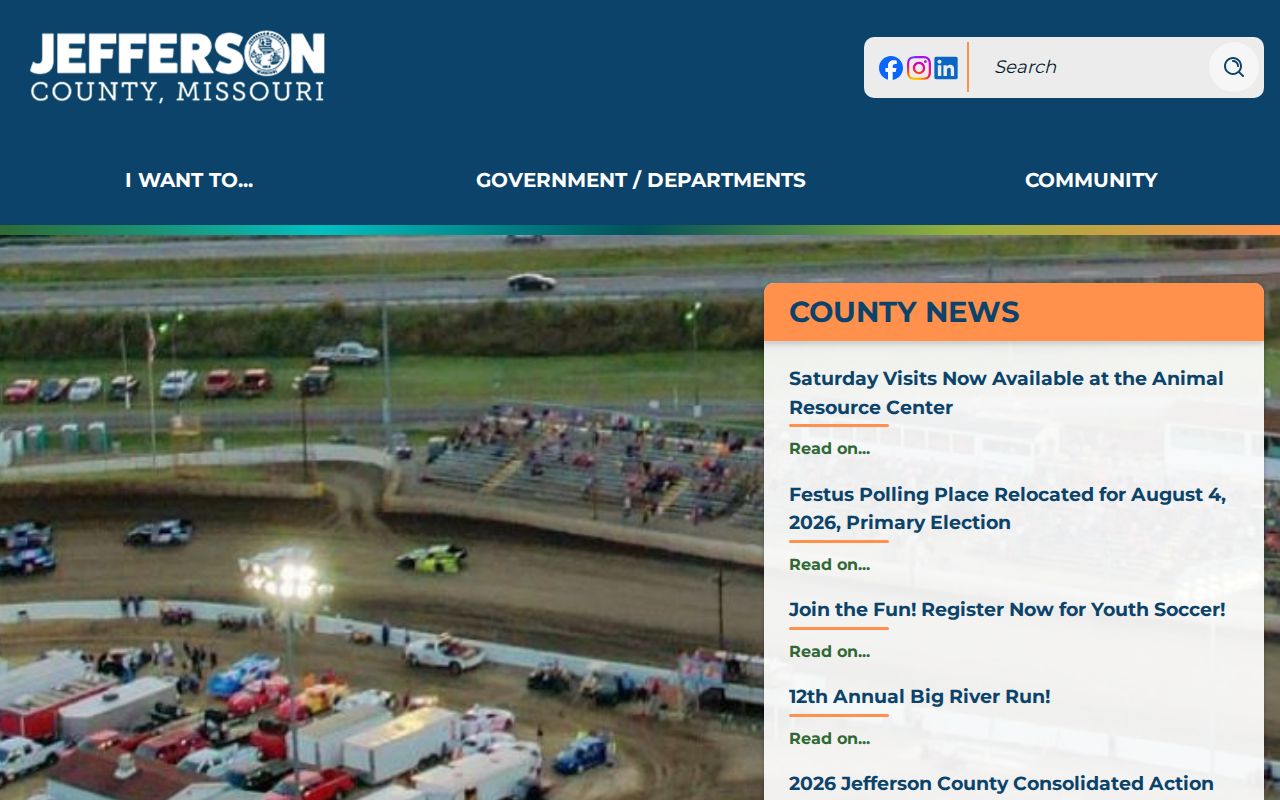
That directory is useful because the general county office, court clerk, sheriff counter, and detention center are not interchangeable destinations.
What a Jefferson County Criminal Record Shows
The fields depend on the source. A Missouri criminal history is organized around identity and arrest cycles. A fingerprint-supported cycle receives an eight-digit Offense Cycle Number. The cycle can connect an arrest date and agency with arrest charges, later prosecution or court changes, a disposition, sentence, and reported corrections or supervision data. The clerk’s case file adds the detailed docket and public documents that a state history does not reproduce.
| Name & Identifiers | Legal name, aliases, birth details, state or FBI identifiers, and fingerprints where authorized. |
|---|---|
| Arrest / Booking Data | Arrest date, agency, booking time, initial charges, bond, holds, and custody status as released. |
| Charges & Statutes | Suspected arrest charges, prosecutor-filed counts, offense citations, class, and alleged date. |
| Disposition | Dismissal, plea, acquittal, conviction, suspended imposition, or another count-specific outcome. |
| Sentence | Custody, probation, fine, restitution, or other terms ordered by the court. |
| Custody / Supervision | County jail status, state placement, probation, parole, release, or transfer information when public. |
Compare count by count. One case may contain several charges with different outcomes. An arrest allegation is not itself a conviction, and the initial booked label is not always the final filed offense.
Jefferson County Charges Change by Stage
A common record error is to treat the first label as the last word. The arresting officer records suspected offenses. Jail staff enter booked charges based on the authority presented at intake. Jefferson County’s Prosecuting Attorney then reviews police material through intake and warrant functions and decides whether, what, and how to file. The court records each filed count and its final outcome.
- Booked charge
- The allegation recorded at jail intake; it can later be amended, replaced, combined, or declined.
- Information
- A formal charging document filed by a prosecutor.
- Disposition
- The result of a specific charge, such as dismissal, plea, acquittal, or conviction.
- Suspended imposition of sentence
- A Missouri result in which imposition is suspended during probation; public access can change after completion.
- Suspended execution of sentence
- A sentence is imposed, but execution is suspended while the person follows probation terms.
Missouri’s class label also matters. Jefferson County Circuit Court hears felonies, while associate circuit and municipal divisions handle lower-level matters assigned by law. Class A through E felonies and class A through D misdemeanors carry different ranges, but an initial booking class is preliminary. Use the filed count and final judgment to identify the class actually adjudicated. Municipal ordinance violations are not state misdemeanors merely because the conduct has a similar name.
For the most accurate reading, place the sheriff report, booking entry, filed charge, and disposition in date order. A conflict may reflect the normal path of a case rather than a data error.
Public Access Laws
The Missouri Sunshine Law favors open government records, yet it does not make every criminal record public in full. Ask the office that created the record, and expect lawful redaction or closure for active investigations, juveniles, protected personal data, and closed cases. Court records also follow Missouri Court Operating Rule 2 and its public security levels.
Key Missouri access rules:
RSMo §610.011 directs broad reading of the Sunshine Law’s open-record policy and narrow reading of exceptions.
RSMo §610.023 requires a records custodian and sets access and response mechanics.
RSMo §610.100 governs access to Missouri incident and arrest records as case status changes.
RSMo §610.120 limits public access to closed criminal records while preserving specified lawful access.
RSMo §610.140 provides the general petition process for expunging eligible Missouri records.
If an office denies part of a request, ask for the legal basis and for any segregable open portion. Narrowing the date range, location, incident number, and media type can also reduce search and copy costs.
Jefferson County Jail and Prison Records
The official Jefferson County inmate search covers current inmates and links to releases from the last 72 hours. It searches by name and orders results by booking date. The sheriff describes booking time and date, charges, and added information, but not every field was visible during research. For recent custody, use that portal or call the jail information line at 636-797-5081. The detention center is at 510 First Street in Hillsboro.
Use MODOC Offender Search after a state sentence or transfer, or when public state probation or parole status is the question. It accepts a DOC ID or name. County jail custody does not become a state prison record merely because a case arose in Jefferson County.
The official MODOC Offender Search displays the state locator interface.
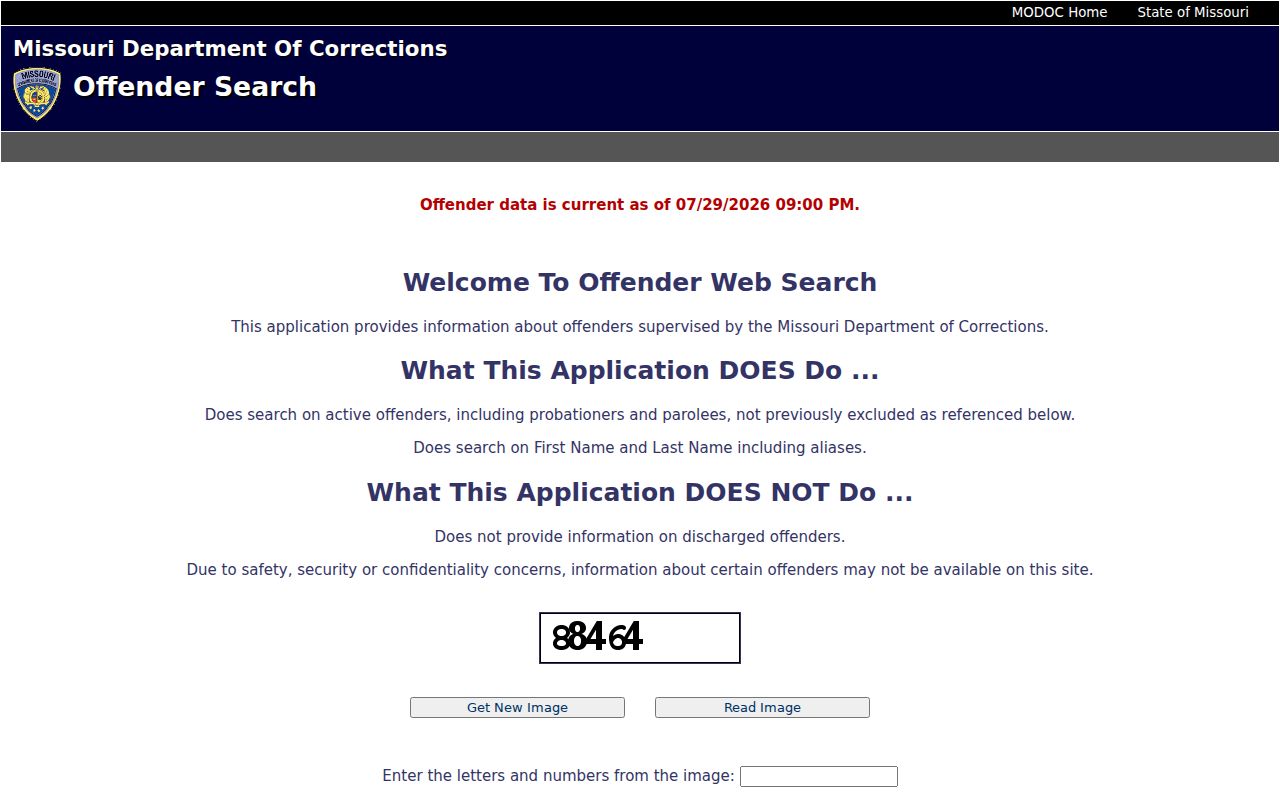
The locator should be read beside the Jefferson County court docket because a custody entry does not reproduce the full case file. JCSO reported 6,691 jail bookings and an average daily population of 226 in 2024. Those are sheriff operational figures, not a count of convictions and not a countywide crime total.
Sealed, Expunged & Restricted
Missouri expungement under RSMo §610.140 begins in the municipal, associate circuit, or circuit court where the person was charged or found guilty. In Jefferson County, that means the division that handled the matter, with the Circuit Clerk serving as the filing counter for circuit and transferred municipal cases. The petition must identify each record and custodian to be affected so the court, prosecutor, arresting agency, MSHP repository, and other named entities can receive notice.
Eligibility depends on the current law, the offense, completion of the sentence and payment terms, waiting periods, pending cases, and statutory findings. Major exclusions include class A and dangerous felonies, registration offenses, and other listed violent or specified crimes. The official 23rd Circuit deposit sheet lists $98.50 for arrest-record expungement, $298.50 for associate-circuit conviction expungement, and $348.50 for circuit-court conviction expungement. Mistaken-identity expungement has no fee. Confirm the correct category and current total with the clerk.
Closed does not mean destroyed. Some agencies can retain or access a closed record for purposes named by law. After an order, keep certified copies, allow agencies time to process it, then check the court display and MSHP history. Juvenile and active-investigation material follows separate rules.
Jefferson County Warrants Need Layered Checks
No verified public sheriff name-search warrant portal was found for Jefferson County. Use Case.net for open warrant and docket events, then confirm a case-specific entry with the court division that issued it. Releasable law-enforcement records can be requested from the sheriff’s custodian. A person trying to resolve their own possible warrant should obtain the exact case number and instructions from the court or counsel, not send funds to an unsolicited caller.
The need for more than one check is visible in the sheriff’s 2024 report. Its Warrants Unit received 11,691 warrants, including municipal, traffic, misdemeanor, felony, and infraction matters. At year end, 14,447 active warrants dating from 2001 through 2024 remained on file. Municipal matters were the largest incoming group, so the issuing city or municipal division can matter.
An arrest warrant authorizes custody on an accusation. A bench warrant or capias often follows failure to appear or comply with a court order. Search warrants may remain sealed before execution, while probation or parole warrants come through supervision authority. A missing public result does not prove that no warrant exists.
Jefferson County Probation and Parole Records
Probation and parole are state-run in Missouri. The MODOC Division of Probation and Parole supervises people placed on probation by circuit courts and people released under Missouri Parole Board authority. Jefferson County is served by District 15 in Hillsboro at 4621 Yeager Road, 636-789-3393. Case.net may show the sentence, violation filings, hearings, warrants, and discharge, while the MODOC locator can show qualifying public state status.
The MODOC probation and parole program page explains the statewide supervision structure and links its published rulebooks.
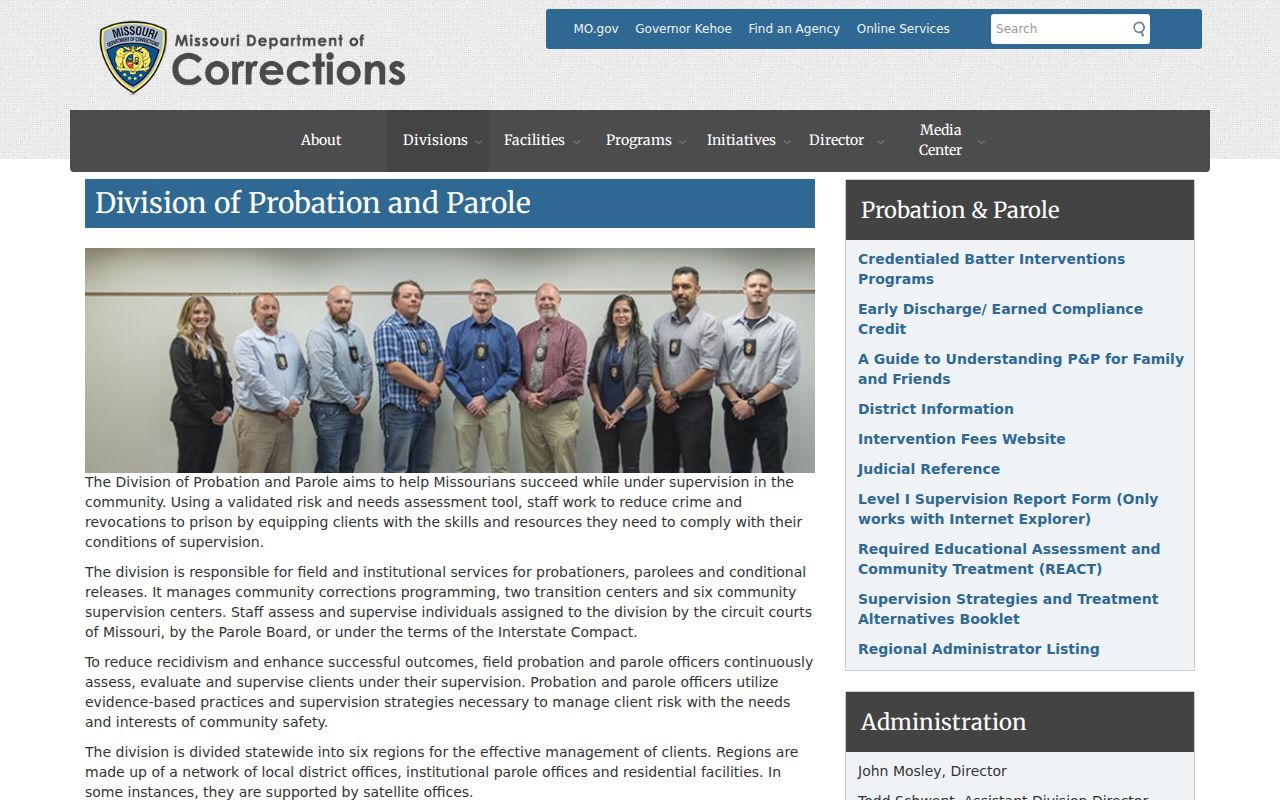
That state source helps interpret local court entries without implying that operational supervision files are fully public.
A technical violation is not automatically a new conviction. The court or Parole Board decides the result through the proper process. Risk assessments, treatment details, addresses, testing information, and victim-protection material may be protected even when basic supervision status is public.
Jefferson County Record Geography Since 2020
Three Hillsboro addresses serve different record roles. The Circuit Clerk’s court counter is at 300 Main Street, opens from 8 a.m. to 5 p.m. on weekdays except state holidays, and answers at 636-797-5443. The sheriff’s report counter is at 400 First Street. General county government is at 729 Maple Street. Sending a request to the wrong building can delay a search because those offices do not hold the same files.
The city-court map changed in 2020. Festus and De Soto dissolved their stand-alone municipal courts and moved ordinance matters into Jefferson County circuit or associate divisions in Hillsboro. Arnold still has a named municipal division at 2101 Jeffco Boulevard. Yet a city police report remains with the city department even when the resulting case is handled through a county court division.
This split reflects Jefferson County itself. Hillsboro is the county seat, Arnold is its largest incorporated city, and the county stretches from the St. Louis suburban edge through smaller railroad and industrial communities. The central court system and local police desks must often be checked together.
Criminal Records by City in Jefferson County
Arnold, Festus, and De Soto are Jefferson County’s three largest incorporated cities by the Census Bureau’s July 2024 estimates. Each city police department keeps the reports it creates. Their court routes differ, so local criminal record searches should begin with the city agency and then follow any booking to the county jail and any filed matter to the proper 23rd Circuit division.
Arnold Criminal History
21,036 residents · Arnold Police records and a local municipal division at the same civic address.
Festus Criminal History
13,730 residents · City police reports stay local while ordinance cases route through the county circuit.
De Soto Criminal History
6,503 residents · Police records remain in De Soto and post-2020 ordinance files sit in associate circuit court.
The city cards use the consistent 2024 population estimate series. A city report and a county case should not be treated as duplicate copies because they document different stages.